
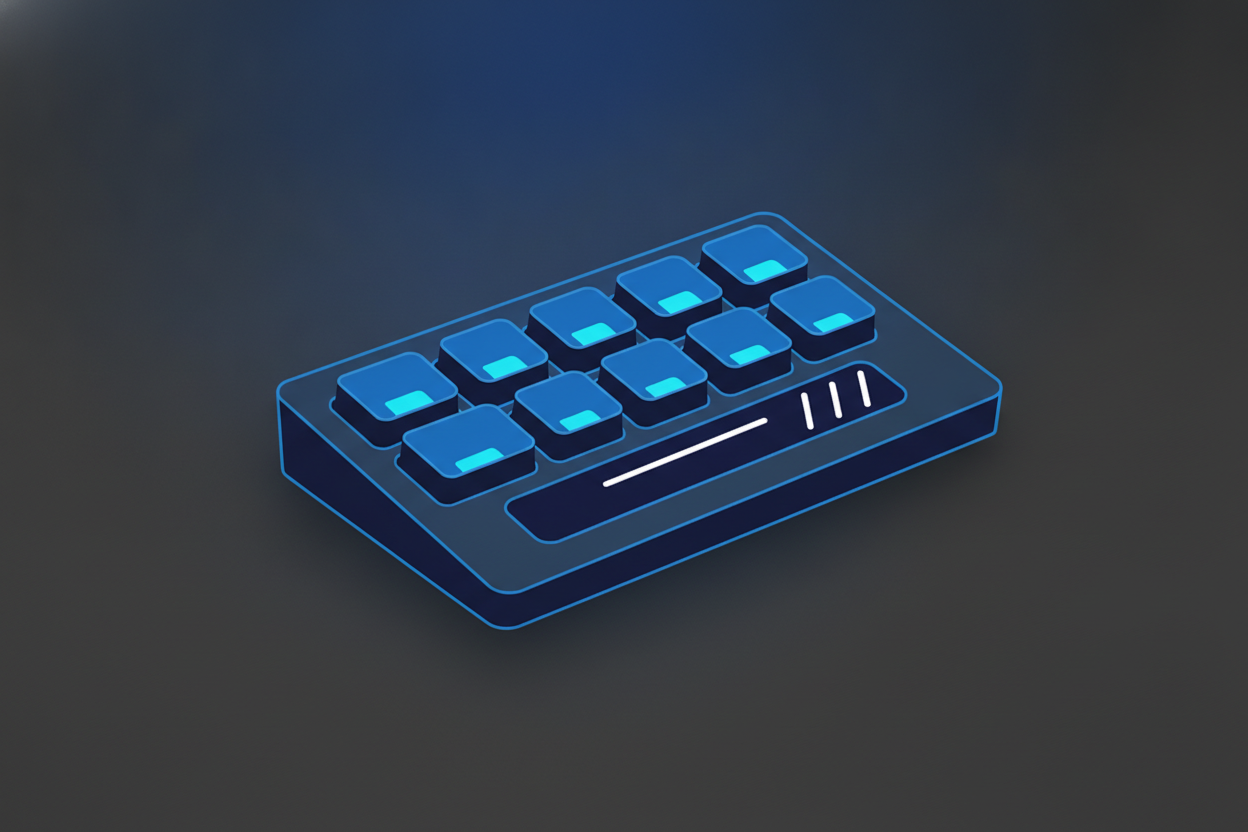
OpenAI's move into hardware with the Codex Micro keyboard is not a peripheral play. It is a statement that AI coding agents have matured from experimental chat-based tools into first-class development infrastructure that demands native control surfaces, real-time feedback, and seamless workflow integration.
Hardware as a Signal of Maturity
OpenAI just launched its first hardware product, a $230 programmable keyboard designed specifically for its Codex AI coding agent. The device is not a full keyboard. It is a macro pad with 13 mechanical keys, a joystick, a rotary dial, and a touch sensor. Six illuminated keys display live task status: running, awaiting feedback, completed, or error.
This is the inflection point. When a company moves from software to hardware, it signals that the product has crossed from experimental to essential. Hardware is expensive to manufacture, inventory, and support. You do not build hardware for a chat interface. You build hardware for infrastructure that developers depend on daily.
The Codex Micro was developed jointly with Work Louder, a specialized keyboard manufacturer, and is positioned as a stylish new way for developers to manage a fleet of AI coders that can write and execute code with minimal human intervention. The collaboration itself is telling. OpenAI did not slap a logo on a generic keyboard. They engineered a purpose-built control surface.
The Tactile Agent Control Problem
Chat interfaces are stateless. You type a prompt, wait for output, read the response, type again. This works for one-off queries. It breaks down when you are orchestrating multiple agents in parallel, each with different states, priorities, and feedback loops.
The Codex Micro solves a real problem that chat cannot: tactile, real-time control. Developers need to see agent status at a glance. They need to interrupt a running task without context-switching to a browser tab. They need to queue commands without losing focus on their IDE. A keyboard macro pad does all of this. A chat interface does none of it.
This is not about ergonomics or aesthetics. This is about workflow integration. The hardware forces a design constraint that improves the product: agents must expose their state in a way that a physical interface can represent. That constraint pushes the entire system toward better observability and control.
Workflow Integration Over Chat Interfaces
The broader pattern here is clear. Atlassian announced a system for AI-native software development in Jira, embedding agent workflows directly into the tools developers already use. OpenAI is doing the same thing with hardware. The message is identical: AI agents are not a separate tool. They are infrastructure that lives inside your workflow.
Chat-based AI tools created a false separation. You had your IDE, your terminal, your design tool, and then you had ChatGPT in a browser tab. You had to context-switch constantly. You had to copy and paste code. You had to manually track what the agent was doing.
Hardware and embedded workflows eliminate that friction. The agent becomes part of your environment, not a separate application. This is the maturation cycle: from novelty to utility to infrastructure.
What This Means for the Vibe Coding Space
Emergent's CEO shared what he looks for in developers in the AI era, and the answer was not "people who can prompt better." It was people who understand how to work with agents as team infrastructure. That requires a different mental model than chat-based AI.
Vibe coding has always been about intuition and iteration. You capture a UI, feed it to an AI tool, iterate on the output, ship. The Codex Micro signals that vibe coding is moving from a solo developer practice to a team infrastructure pattern. When you have multiple agents running in parallel, each with different tasks and states, you need real-time visibility and control. You need hardware.
This also means that AI agents need runtime context, not just models. The keyboard is not the point. The point is that agents are becoming stateful, observable, controllable systems that live inside your development environment. That requires infrastructure that goes beyond language models.
The Real Cost of Agent Orchestration
Here is what nobody is saying out loud: the Codex Micro costs $230. That is expensive for a keyboard. But it is cheap for the infrastructure it represents.
When you have one agent, chat works fine. When you have five agents running in parallel, each with different priorities and feedback loops, you need orchestration. You need visibility. You need control. The cost of that infrastructure is not just the hardware. It is the entire system: the agent runtime, the state management, the feedback loops, the observability layer.
OpenAI is betting that developers will pay for that infrastructure because the alternative is chaos. And they are probably right. AI agent infrastructure beats model innovation. The model is table stakes. The infrastructure is the moat.
The Codex Micro is not a keyboard. It is a signal that the AI tooling space has moved past the "chat interface" phase and into the era of embedded, stateful, observable agent infrastructure. Developers who understand this shift will build faster. Teams that do not will get left behind.